Know the risk.
Before you click.
Inspect a URL’s structure with machine learning. Get an estimated phishing risk, recognizable warning signs, and transparent model evidence.
Check a URL
Paste the complete address, including http:// or https://. Analysis uses URL text only.
Examples demonstrate patterns. They do not establish whether a live website is safe.
Understand the address before acting
See its estimated risk, effective hostname, and observable indicators.
Effective hostname
Last analyzed URL
Model phishing estimate
Low <30 · Medium 30–<70 · High ≥70
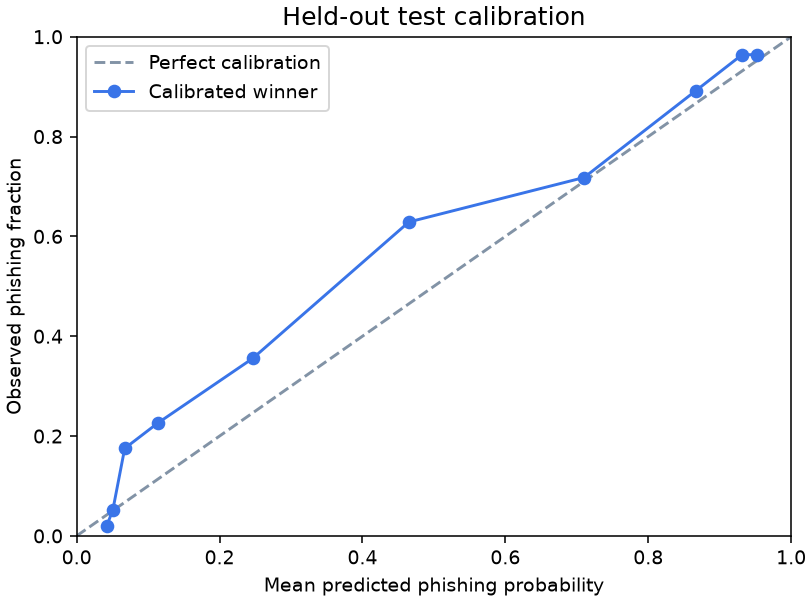
Model score = calibrated P(phishing) × 100 on historical URL data. Domain warnings require independent review and leave the model score unchanged.
Observed URL indicators
URL breakdown & extracted features
| Feature | Value |
|---|
Model evidence
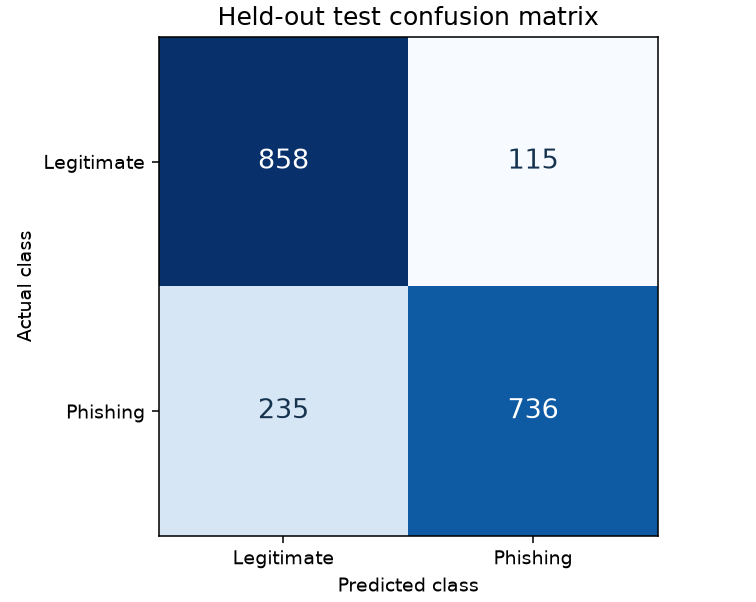
Historical evaluation of this release. No live reputation or webpage content is checked.
Trained on the Hannousse–Yahiouche URL dataset, with separate domain groups for training, selection, calibration, and testing. Test cohort: 1,944 URLs. The browser uses the exported 200-tree forest and its original sigmoid calibration.
Download release manifest · Prediction parity report · Original project
Recheck Python prediction parity in this browser
Runs the full published comparison set in a background worker. This may take about a minute. No test URLs are visited.
Dataset: Hannousse & Yahiouche (2021), Web page phishing detection v3, CC BY 4.0. Code: MIT. See release manifest for source revision, checksums, and attribution.